Whatever happened to Project Xanadu?
Status: essay (canonical) · Date: 2026-11-19 · Also readable on Medium, which carries the link back here.
The hypertext dream that didn't die.
You have felt the problem, even if you never had a word for it.
An article you loved is gone — the domain lapsed, the page moved, and the link that promised it now points at nothing. A quote you screenshotted has no way back to its source; you own a copy of the words and none of the thread. You publish something and have no idea who is pointing at it, because on this web, links point and targets stay silent. Connections rot. Copies drift. Nobody is home.
This was all foreseen, and it was all designed against — starting in 1960.
The man before the word
In 1960, a twenty-something American named Ted Nelson started a project he would describe, decades later, as the one thing he never finished and never abandoned. He was thinking about writing on screens — this is before screens were ready for it — and he came to a conviction that sounds obvious now and was radical then: that the real subject was not documents but connections between documents, and that those connections deserved to be first-class citizens of the writing system itself.
He coined a word for it: hypertext. The term first appears in print in his 1965 paper "A File Structure for the Complex, the Changing, and the Indeterminate" — delivered at that year's ACM national conference — though by Nelson's own account the word was coined in 1963 and the ideas were years older still. He named the project Xanadu, after the pleasure-dome in Coleridge's "Kubla Khan": a fragment of a vision, half dream, half monument, famously never completed. The name was chosen with a wink. It turned out to be more accurate than anyone wanted.
Nelson was standing, self-consciously, on older shoulders — Vannevar Bush's 1945 Memex essay "As We May Think" had already imagined a scholar's desk of linked microfilm. But Bush had imagined a private memory machine. Nelson wanted literature itself — a public, connected, permanent system for what people write to each other.
What it promised
Strip away the decades of legend and the design rests on a handful of commitments, each one plain enough to say in a sentence.
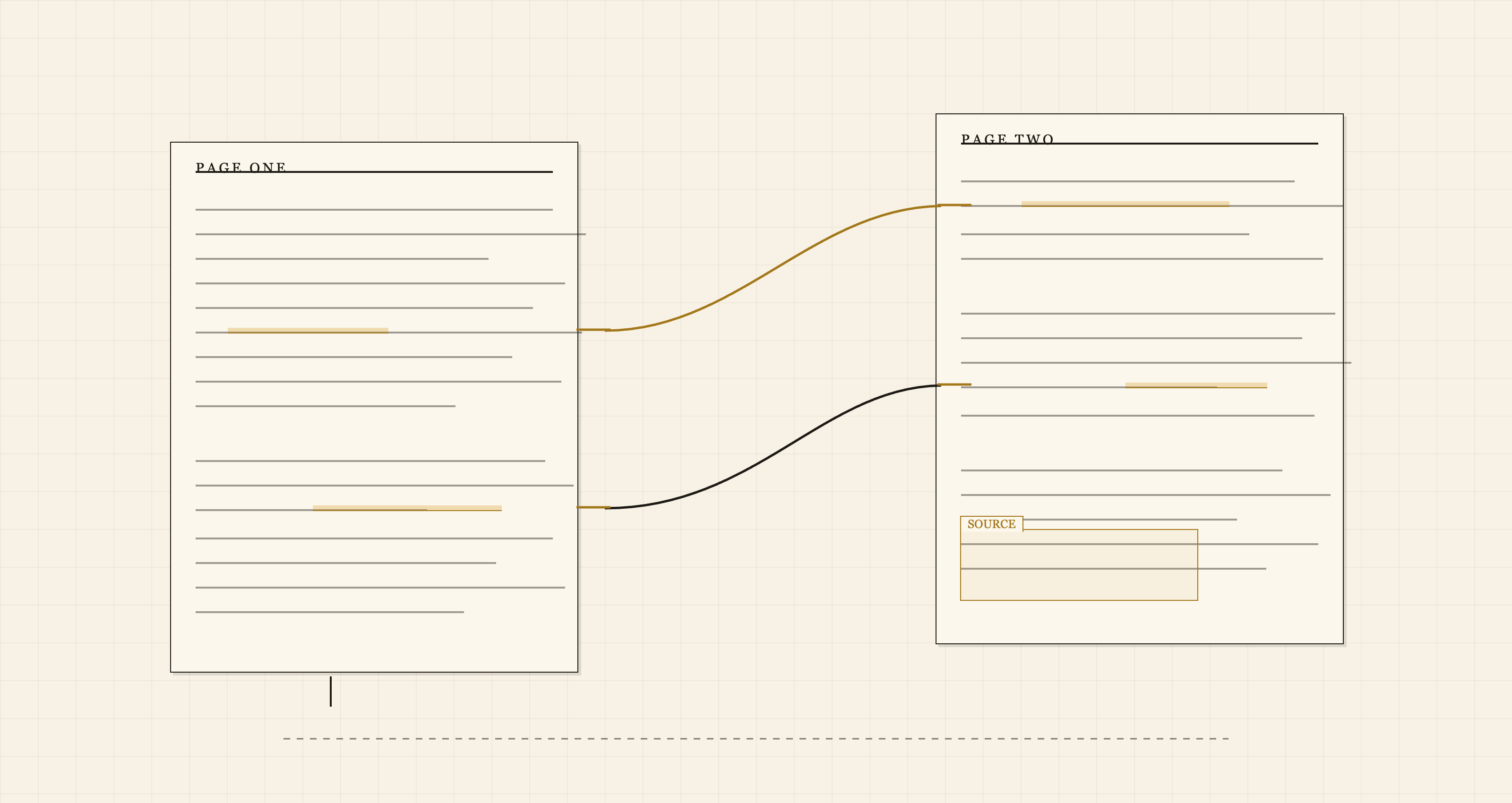
Every link points both ways. A connection between two passages is visible from both ends. Publish something and you can see everything that points at you — not as a favor granted by a search engine, but because the system is built that way. Nothing links to you secretly; nothing links to you silently.
Quotation without copies. Nelson's most famous idea — he called it transclusion: the same content, used in many places, but living in only one. When you quote in this system you open a window onto the original text. The words appear in your page, but they are not a copy that will drift out of date; they are the thing itself, seen from where you stand. If the original is corrected, every window onto it corrects too.
Connections that cannot break. Links attach to passages, not to page filenames, and the addressing scheme was designed so that a connection survives editing. The sentence you pointed at moves within the document, the document is revised, the passage is restructured — and the connection follows its words. Link rot, designed out from the start.
Documents in parallel. Not one current version with the past discarded, but editions standing side by side, connections visible between the passages of one and the passages of another. The 1972 sketches of this posture — pages in parallel columns, lines drawn between connected passages — still look like something the web never shipped.
Quote freely, pay automatically. The economic layer, "transcopyright": quote anything, and rights-holders are paid micropayments per view through the quotation chain. This is the piece that has aged most strangely — and the piece most later builders, honestly, drop. (The system this essay ends at drops it too, on a simple design rule: the server never touches money.)
None of this required smarter computers than the web eventually had. It required a different shape of document — and that is what Xanadu spent its decades designing.
The long road
The project's history has been told as tragedy, farce, and warning, depending on the decade. In the 1970s Nelson published the movement's twin bibles, Computer Lib / Dream Machines, self-published and evangelical. Through the early 1980s a core design team iterated the deep architecture — the data model, the addressing, the swirling, general solution. In 1988 the project landed real institutional backing: Autodesk, the CAD software giant, took Xanadu in and funded it. In 1992, Autodesk set it back out, and the code was rewritten once more in Smalltalk.
Then came 1995, and the folklore hardened. The Web — Tim Berners-Lee's CERN creation, shipped in 1991 — was eating the world with the simple version of the idea: one-way links to whole pages, copies by default. That June, Wired ran Gary Wolf's "The Curse of Xanadu" — a long, withering profile of Nelson and the project. The verdict of the era stuck: Xanadu became the textbook example of vaporware — the grand design that never shipped, defeated by its own grandeur.
There was truth in it and it wasn't the whole truth. The web had won by shipping, and it shipped a fraction of the vision. But the project never ended. Through the late nineties Nelson and a small group continued, now in Japan, and in 1999 they did something quiet and enormous: they released the source code of the project's mature backend — the system by then called Udanax Gold — under the Xanadu X11 license, a permissive open-source license. Free to read, free to use, free to build on.
And there it sat, largely unnoticed, for a very long time.
The ideas kept leaking out
Here is the strange part: you already use Xanadu's ideas every day — in degraded, partial forms that keep being reinvented because the underlying needs never went away.
Wikipedia's "what links here" is a backlink, bolted on. Blog trackbacks were backlinks, worse. The note-taking tools of the last decade — Roam, Obsidian and their descendants — built their whole appeal on bidirectional links, one of Xanadu's 1963 commitments. Embeds and iframes gesture at transclusion but deliver copies in disguise. Annotation overlays try to add the connection layer the web never had. The design writer Maggie Appleton, in her essay "The Pattern Language of Project Xanadu," has catalogued how these patterns keep resurfacing across the modern web in half-realized forms — worth reading precisely because the patterns she lists are the ones the web keeps reinventing badly.
The fragments won. The whole never shipped.
So — whatever happened to it?
Three things, none of them the folklore answer.
Nelson is alive, in his late eighties, and still publishing — the project's founder outlived its obituary by decades. The ideas won in fragments while the whole became a legend. And the code is public: the 1999 release is still there for anyone to read, and it is not a sketch — it is years of deep design, distilled into a working system that implements the commitments above: two-way connections, transclusion, unbreakable links, documents in parallel.
Which raises the obvious next question, and it is the reason this essay exists: what does that actually look like, running?
I'm one of the people who went back to the source. Over the past years I translated the 1999 Udanax Gold codebase into a modern systems language and built on top of it — an independent, open-source project called Xudanu, which is where the quotation system above drops the micropayment layer (the server never handles money) and keeps everything else. It is live now, and its front door was built to answer exactly this essay's question: you open it and you are reading in the 1972 posture — parallel pages, visible connections drawn as beams between the passages they join, quotations that are windows onto their originals, each passage carrying the signature of whoever wrote it.
Xudanu is an independent project — not affiliated with, endorsed by, or sponsored by Ted Nelson or Project Xanadu; the trademark belongs to its holders, and the lineage is acknowledged with gratitude, not claimed as authority.
Whatever happened to Project Xanadu? It happened slowly, it is still happening, and for the first time in a long time you can walk through a door and read inside the design instead of reading about it.
The door is open: https://xudanu.com