Xudanu Documentation
A hypertext document store built on the Udanax-Gold foundation with modern enhancements: BLAKE3 content addressing, CRDT collaborative editing, cryptographic author attribution, real-time transclusion queries, trails, document map, and content similarity.
The Classic Client START READING
Parallel pages, visibly connected — the Xanadu reading posture, running on the same server and the same document universe as everything else on this site. Every underline below is a real typed two-way link; every ink line runs from passage to passage. The server’s front door opens here; the full editing workspace is one click away (workspace ↗) when you want provenance panels, gathers, and live collaboration.
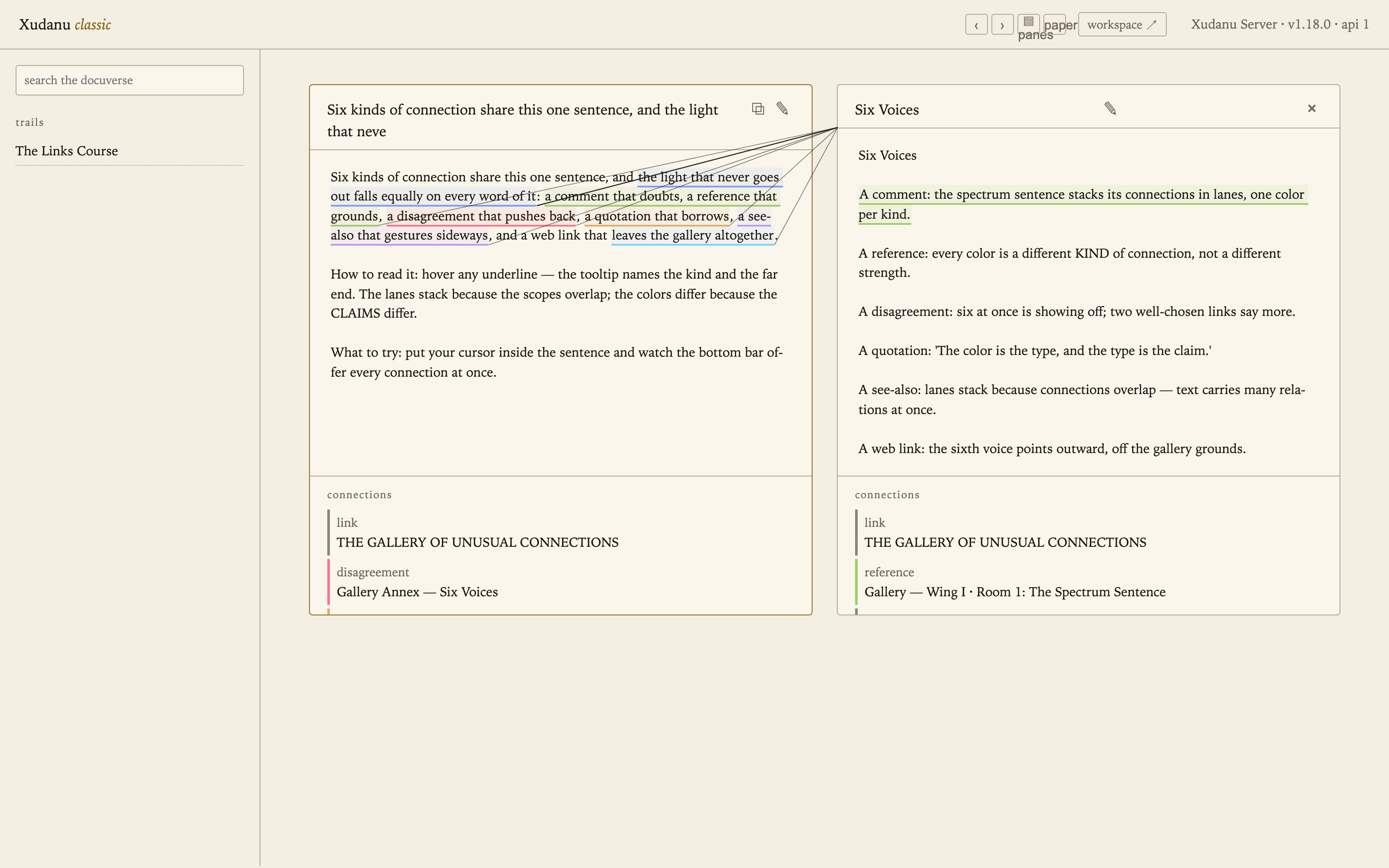
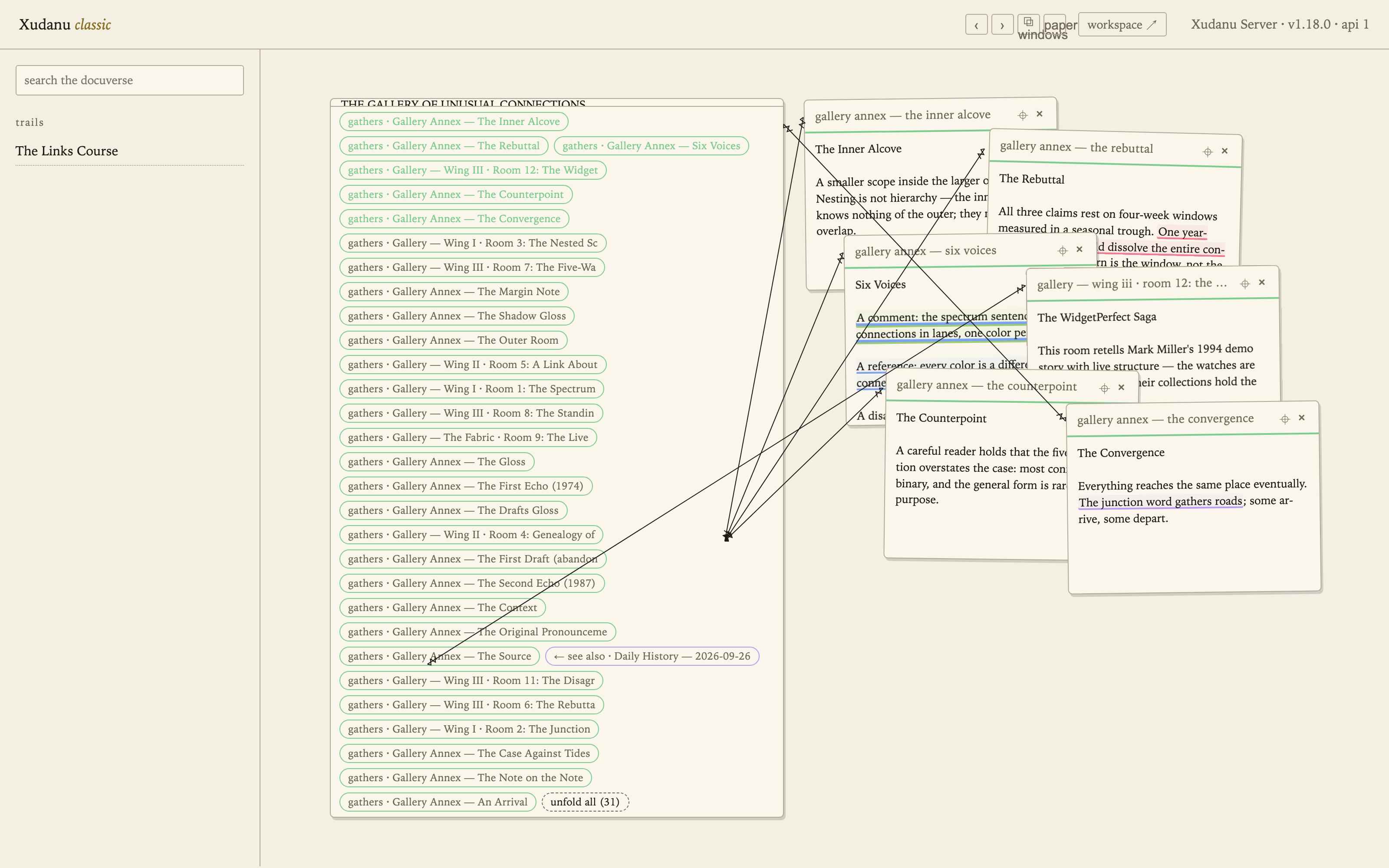
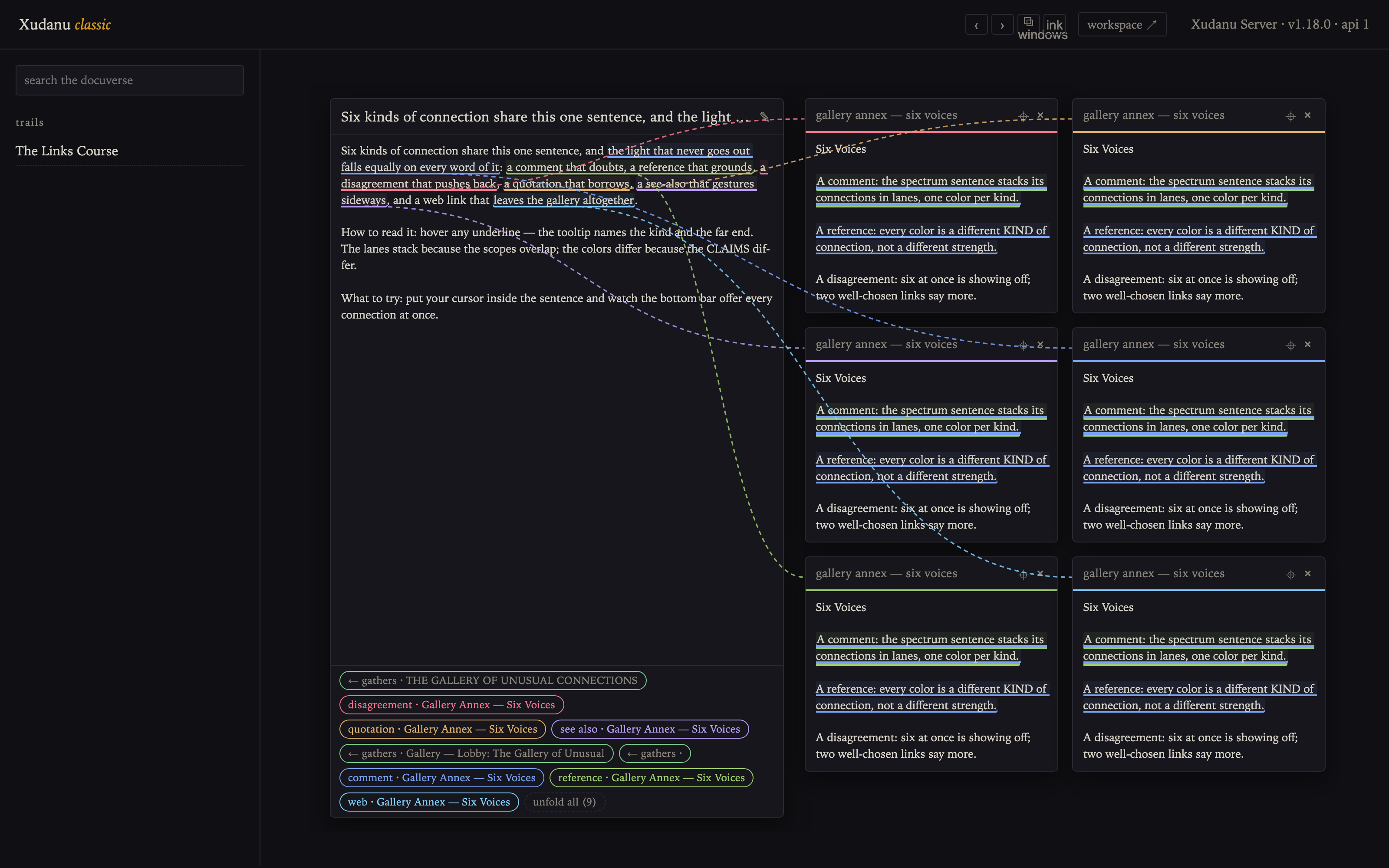
New: Classic vs Workspace — a side-by-side guide to the two postures over one docuverse.
Editable in place: select a passage, connect it, revise the text — grab-and-revise with exclusive holds, the Gold-heritage transaction model. Source and releases on GitHub.
Xudanu at a Glance CLICK ANY REGION
The fundamental pieces, end to end. Click any region to open its deep-dive page.
Getting Started START HERE
Start here if you're new to Xudanu.
User Guide (v0.7.0)
Complete guide to the web UI: editing, stars, trails, document map, transclusion, attribution, revisions, and persistence.
html new in 0.7.0README
Quick Start guide, prerequisites, CLI reference, security notes, and macOS Gatekeeper instructions.
markdownUser Manual
Complete manual covering server setup, web UI guide, command bar, document operations, and troubleshooting.
markdownTLS Setup Guide
Configure HTTPS and WSS for encrypted connections. Self-signed certs, Caddy reverse proxy, and Safari compatibility.
markdownStars / Favorites
Star documents to mark them as favorites. Starred docs appear in a dedicated sidebar section and as amber nodes in the Document Map.
newWhat People Said Killed Project Xanadu
The four standard objections to the 1960 design — never implemented, backlink spam, micropayments, over-complexity — answered by a running xanalogical system in 2026.
newXudanu in One Page
Content and performance architecture diagram on a single page. The complete system at a glance: O-tree, chunk store, WAL, CRDT, federation, and the wire protocol.
htmlCollaborative Editing
Real-time multi-user editing with O-tree CRDT, Ed25519-signed author attribution, awareness state (cursors/selections), three-way merge fallback, and LLM-assisted change narration.
8 sections · 1 diagramNotification System
Real-time notification and event system for collaborative editing sessions.
interactiveDocuments & Storage CORE
How content is stored, versioned, and managed. A Xudanu document is an edition — an immutable snapshot of text and structure. Editions are organized into works, persisted in chunks, and tracked through a version DAG.
Editions & Works
How documents are structured as versioned editions with per-line attribution, three-way merge, and the O-tree data model. Essential reading for understanding Xudanu's core abstractions.
10 sections · 10 diagramsStorage System
BLAKE3 content-addressed chunk store, incremental checkpoints, garbage collection, and integrity verification.
13 sections · 11 diagramsEnt, DagWood & Trace DAG
The versioning spine adapted from Udanax-Gold C++: partial-order TracePositions, Root/Tree/Dag branch topologies, the navigation cache (max-over-paths), assertion-based content with 13 payload types, conflict-preserving AlternativeSet materialization, the H-Tree, and the bridge to the Edition model — with code examples and SVG diagrams.
18 sections · 7 diagramsManifest & Chunk Architecture
How manifest.json uses hash pointers to reference document content in the chunk store: WorkChunkRef, EditionChunkRef, EntryChunk, ProvenanceChunk, and the three-layer link persistence model.
featuredGarbage Collector
How the GC reclaims disk space: mark-and-sweep algorithm, chunk write path, WAL journaling, and the v0.7.5 safety fix.
html newStorage System
Content-addressed BLAKE3 chunk store, incremental checkpoints, garbage collection, and integrity verification. 13 sections with SVG diagrams.
html featuredHardened Persistence
Three-layer data protection: Write-Ahead Log, dual manifest slots (A/B), and atomic fsync+rename checkpoints every 5 seconds.
newPaths, Snapshots, Endorsements
Label sequences through nested editions, snapshot persistence, and the endorsement system.
markdownConnections & Reuse HYPERTEXT
How documents link to, reference, and include each other. Xudanu's core innovation is visible, typed connections between specific passages — combined with transclusion (live content reuse) that tracks provenance back to the original source.
Links & Backlinks
Nelson's typed, bidirectional, unbreakable connections between passages. The five link types (Comment, Reference, Disagreement, Quotation, See Also), the two-part creation flow, backlinks, span migration, and profuse overlapping links — with code examples and canvas-render diagrams.
14 sections · 9 diagramsTransclusion Architecture
How Xudanu implements content reuse: range-based transclusion with BLAKE3 hash verification, recursive resolution, span migration, reading vs authoring modes, and how our approach compares to Gold's enfilade/I-stream model. Includes working screenshots and the FR-26 content-addressed transclusion lifecycle.
Our variant explained · Gold comparison · screenshotsTransclusion Engine
How content reuse is detected, indexed, and queried across documents: BLAKE3 fingerprinting, Bert Canopy tree, Recorder pub/sub, Hoist propagation, and Backfollow queries. The core intellectual property of Xanadu.
9 sections · 3 diagramsProvenance & Cryptographic Attribution
How Xudanu answers "who wrote this?" at the character level. Ed25519 span signing, content fingerprints, domain separation, the materialization pipeline, transclusion attribution, historical attestation for imported texts, the tamper-evident SHA-256-chained attribution log, provenance ancestry walks, exportable attestation reports, and federation cluster consensus with W3C PROV-JSON export.
23 sections · 7 diagramsCompound Documents
How live transclusion works: inline RangeElement::Transclusion in the O-tree, recursive resolution, attribution propagation, span migration, and the visual Compound Builder for assembling passages from multiple sources into one editable view.
html newCompound Builder Guide
Visual builder for assembling compound documents from transcluded passages. Drag, drop, and rearrange live content from multiple sources into a single editable view.
html newCompound Tutorial
Step-by-step user guide for compound documents: creating transclusions, seeing colour-coded source regions, the compound panel, and the legal brief assembly example. Includes comparison with Udanax-Gold.
html newLinks Tutorial
Step-by-step user guide for creating links and backlinks: using the Link Creator wizard, choosing link types, creating transclusions, managing existing links, and understanding the visual markers.
html interactive walkthroughDocument Map
Force-directed graph showing all documents, transclusion links (solid lines), and content similarity (dashed lines). Click nodes to navigate.
newTrails
Create ordered reading paths through your documents — Nelson's original concept of guided sequences through hypertext.
newContent Similarity
Documents with overlapping vocabulary (>15% Jaccard similarity) are connected with dashed lines and drift together in the Document Map.
newPROV-JSON Validator
Interactive W3C PROV-JSON validator for Xudanu's attribution export. Paste a report, see the provenance graph, verify signatures and timestamps.
htmlStorage & Rendering Architecture
How Xudanu stores documents, revisions, and images — and how they flow through the system to appear on your screen. Diagrams the 5-layer stack, disk layout, image upload flow, and revision persistence across restarts.
html newTransclusion Plan
Plan for connecting BackfollowEngine, canopy, recorder, and ENT into a working transclusion detection pipeline.
markdownMathematical Foundations MATH
The position algebra and tree structures that make precise content addressing possible. These power span migration (links survive edits), intercomparison (finding shared passages), and efficient tree traversal.
Document Space: Tumblers and Enfilades
The mathematical foundation underlying every position, region, span, mapping, and address in Xudanu. The four core traits (Space, Position, Region, Dsp), the transition-set representation, the seven concrete spaces (Integer, Real, Sequence/Tumbler, CrossSpace2, CrossSpaceN, FilterSpace), span migration, shared-content detection, and tumbler addressing for federation — explained from the ground up for developers.
20 sections · 9 diagramsCanopy (Bert Tree)
The hierarchical property tree that indexes content for fast transclusion queries. Built atop the Space Algebra, the Canopy maps regions to properties and powers backfollow lookup — the structural heart of content reuse and intercomparison.
within Transclusion Engine · deep diveIdentity & Security SECURITY
Who you are, what you can access, and how content is verified. Xudanu uses cryptographic signatures (Ed25519), Argon2id password hashing, and a club-based permission system inherited from Udanax-Gold.
Identity & Authentication
Clubs (the Udanax-Gold identity model), the lock hierarchy (Boo/Wall/Challenge/Match/Multi), KeyMaster authority tracking, Ed25519 provenance, and per-session security monitoring.
8 sections · 1 diagramCryptography & Security
Production-grade crypto stack: Ed25519 signatures, X25519 key exchange, ChaCha20-Poly1305 AEAD, HKDF-SHA256 domain separation, and Argon2id password hashing.
markdownNetwork & Federation FEDERATION
Connecting Xudanu servers across the internet. Tumblers provide stable hierarchical addresses for content on any server. Cross-server backlinks, BLAKE3 hash verification, and the federation protocol let documents span multiple independent servers.
The Xanadu Network Guide
Verified end-to-end: two servers sharing content via tumblers, automatic bidirectional backlinks, click-to-resolve content fetch with BLAKE3 verification. Includes setup guide, tumbler format, security model, and Gold heritage comparison.
verified Jul 2026 · working demoThe Xanadu Network & the Docuverse
How independent Xudanu servers form a connected literature. The tumbler address space, content sharing without replication, transclusion across server boundaries, BLAKE3 content addressing, three-layer verification (tumbler + hash + Ed25519), server operator responsibilities, scaling to hundreds of servers, and the risks and mitigations of hostile machines in the network.
12 sections · 6 diagramsFederation Trust Boundary Analysis
A security audit of the multi-server federation layer. Maps seven trust boundaries from connection admission through governance, catalogs 14 authorization gaps by severity (CRITICAL/HIGH/MEDIUM/LOW), and provides a phased remediation roadmap to align federation access control with the single-server club model. Includes safe deployment patterns for current-state operation.
13 sections · 3 diagrams · 14 gaps cataloguedFR-6: Linked Independent Servers
Lightweight multi-server model using tumbler resolution instead of data-replicating clusters. Each server is sovereign; cross-server content references via tumbler addresses with BLAKE3-verified caching. Handles hundreds of servers, offline machines, and hostile actors. Replaces FR-3 as the default multi-server architecture.
markdown proposedFR-6 Implementation Stories
10 ordered user stories for building the linked independent server model. Covers server identity, directory, public content API, reference manifests, cross-server resolution, offline caching, provenance chains, trust management, referral discovery, and mothballing the FR-3 cluster.
markdownFederation Activation
How to enable and operate the optional cluster federation: the outbound dialer, PeerPool, periodic sync and heartbeat, and PBFT broadcast. Operational guide for running federated nodes — enabled by --peer flags, closed mode by default, with genesis pinning (--pin-members) and 4-node BFT governance.
Micropayments & Cost Model
Ted Nelson's micropayment vision, storage cost accounting, the utility meter, and per-use billing — the economic layer for a federated docuverse.
markdownDeveloper Guide BUILD
For contributors building on Xudanu. Technical architecture deep-dives, wire protocol specifications, test documentation, and phase-by-phase development history.
Technical Architecture
15-section deep dive with 9 SVG diagrams, worked examples, and Big-O analysis of every data structure.
9 diagrams · interactiveDetectors — a Programmer's Walkthrough NEW
The first of the feature walkthroughs: what a detector is (Miller's fourth fundamental feature), the WidgetPerfect scenario, the four wire operations, and a runnable script — examples/detectors.mjs — that exercises the whole surface in one pass.
Architecture & Design
System Overview
Xanadu Gold as a Rust library compiling to WebAssembly. High-level component map and design philosophy.
markdownThree-Layer Architecture
Separation of the core hypertext engine from the applications and clients built on top of it.
markdownContent Model
The Udanax-Gold content model where content is identity — bytes are their own addressing key.
markdownThe 17 Rules of Xanadu
Nelson's original 17 rules for Xanadu systems with xudanu's compliance status for each rule.
markdownRule 8: Publication Model
How Xudanu's publication model compares to the original Udanax-Gold and Nelson's specifications.
markdownArchitecture Diagram
Full system architecture diagram showing the relationship between O-tree, chunk store, WAL, CRDT sync, wire protocol, and federation layers.
htmlAPI, Protocol & Testing
API Reference
Wire protocol API reference (v2). WebSocket JSON message format, all operations, request/response schemas.
markdownProtocol & Audit
WebSocket protocol details, session lifecycle, and server-side audit/logging capabilities.
markdownIntegration Guide
How to integrate Xanadu Gold into a JavaScript or TypeScript application.
markdownCustom Frontend Guide
Building custom frontends that connect to the xudanu server over its WebSocket JSON API.
markdownTest Registry
Index of the test suite: backend library tests, integration tests, and frontend Vitest specs, with what each covers and how to run them.
markdownGold Heritage & Comparison
30 Years of Hypertext Innovation
The history of Xanadu from Nelson's 1960 vision through Udanax-Gold to Xudanu. Timelines, key people, and how the concepts evolved over six decades.
htmlUdanax Gold Heritage
Side-by-side concept mapping: every Gold type, module, and subsystem traced to its Rust descendant, with SVG diagrams and status badges.
html featuredXanadu Gold Foundations
Progressive implementation of Udanax-Gold: transclusion with provenance, content addressing, clubs/permissions, cryptographic attribution, and trails.
enhancedWhat's New Since Gold
New features beyond Gold: cryptographic provenance, CRDT editing, BLAKE3 content addressing, OAuth, federation, and more.
htmlGold vs. Xudanu Complexity
Subsystem-by-subsystem complexity comparison between Udanax-Gold and Xudanu: lines of code, data-structure footprint, and where modern Rust simplifies the original C++ design.
htmlUdanax-Gold vs. OpenXanadu vs. Xudanu
Comparative analysis across three Xanadu lineages: feature coverage, architectural choices, and implementation maturity.
htmlXudanu: What's New Since Udanax Gold
Markdown comparison of what Xudanu adds, changes, and drops relative to the original Udanax-Gold codebase.
markdownMigration Notes
Tracking the port from Udanax-Gold C++ to Rust. Edition, XnRegion, RangeElement, and connected components.
markdownImplementation Phases
Design documents for each phase of the Rust implementation, from core data structures through federation.
Phases 4–6: Mapping, FeText, Wrappers, Clubs
Mapping algebra, text manipulation, type wrappers with certification, and the club-based permission hierarchy.
phasePhase 7: Label & Identity Unification
Label system and identity unification — two critical features from the Udanax-Gold model.
phasePhase 8: Bundle Retrieval & Storage Cost
Reading content from the document store and storage cost accounting for editions.
phasePhase 9: Shared Content Mapping
Content-fingerprint-based shared detection and proper mapping types beyond positional matching.
phasePhase 10: Full Transclusion Queries
Range-based transclusion queries and an ordered bundle stepper with merge-sort for the O-tree.
phasePhase 11: Recorder, Fossil, Agenda
Persistent queries that accumulate results over time, plus admin health monitoring.
phasePhase 12: Modern Encryption
Production-grade cryptography: Ed25519, X25519, ChaCha20-Poly1305, HKDF-SHA256, Argon2id.
phasePhase 13: Endorsement Authority
Endorsement system wired into the server API with authority validation.
phasePhase 15: Server-to-Server Transport
Mutual authentication and encrypted channels between federated servers.
phasePhase 16: Content Replication
G-Set CRDT with BLAKE3 verification for cross-server content replication.
phasePhase 18: DagWood Reconciliation
The Reconciliation Plane — mutable state via DagWood for concurrent edit resolution.
phasePhase 19a: Trust & Membership
Web-of-trust join protocol and membership management for federated servers.
phasePhase 19b: Governance (PBFT)
Governance Plane using lightweight PBFT consensus for federation-wide decisions.
phase